
Why Did My Orthodontist Ask Me to Wear Rubber Bands?
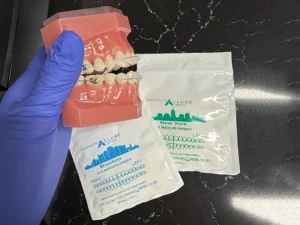
You finally got used to your braces or clear aligners, and then your orthodontist hands you a tiny bag of rubber bands and gives you one more thing to remember every day. It is reasonable to wonder whether something so small can really make much of a difference.
The answer is yes. Orthodontic rubber bands, also called elastics, can play an important role in correcting your bite. Your braces or clear aligners do most of the work of moving and straightening your teeth, but sometimes your orthodontist needs to apply additional force in a specific direction. That is where rubber bands come in.
At Glow Dental in Freeport, NY, we want our orthodontic patients to understand not only what we are asking them to do, but why we are asking them to do it. And when it comes to rubber bands, understanding the reason behind them can make it a little easier to remember to wear them.
Straight Teeth Are Only Part of Orthodontic Treatment
Most people think the goal of orthodontic treatment is simply to make crooked teeth straight. That is certainly part of it, but your orthodontist is also paying close attention to how your upper and lower teeth fit together when you bite.
You can have teeth that look beautifully straight but still have a bite that needs improvement. The upper teeth may sit too far forward compared with the lower teeth, the lower teeth may sit too far forward, or some upper and lower teeth may not contact properly when you bite down. In other cases, the teeth are almost where we want them, but they need some final adjustments to fit together more naturally.
Braces and clear aligners are excellent tools for moving teeth within each arch. Rubber bands allow us to create additional forces between the upper and lower teeth. Depending on where your orthodontist attaches them, elastics can help guide the teeth in different directions and improve the way the bite comes together.
Why Was I Asked to Wear Rubber Bands?
There is no single rubber band pattern that works for everyone. Your orthodontist chooses the size, strength, and location of your elastics according to your unique bite and the movements we are trying to accomplish.
For example, elastics may be used as part of correcting an overjet, where the upper front teeth sit too far ahead of the lower front teeth. A different elastic pattern may be used to help correct an underbite, where the lower teeth sit ahead of the upper teeth.
Rubber bands can also be helpful in treating certain open bites. An open bite occurs when some of the upper and lower teeth do not touch when you bite down. Depending on the cause of the open bite and the overall treatment plan, elastics may help bring certain teeth into better contact.
We also frequently use elastics when the teeth are already looking much straighter but the bite still needs some fine tuning. You may hear your orthodontist talk about “settling” your bite. This simply means we are working on getting the upper and lower teeth to fit together as well as possible before treatment is finished.
This is also why you should never copy someone else’s rubber band pattern. Your friend may have braces too, but the movement their orthodontist is trying to achieve could be completely different from yours.
Do I Really Need to Wear Them as Much as My Orthodontist Says?
This is probably the most important thing to understand about orthodontic elastics: they only work when you wear them.
Your orthodontist can create the treatment plan, place your braces, design your clear aligners, and prescribe exactly where your rubber bands should go. But this is one part of orthodontic treatment that depends heavily on you.
Orthodontic treatment works by applying carefully controlled forces to teeth over time. If you have been instructed to wear your elastics consistently but only put them on occasionally, your teeth are not receiving the force as consistently as your orthodontist intended. That can mean your bite does not improve as expected and, in some situations, treatment may take longer.
And yes, we can usually tell when the rubber bands have only been making special appearances right before your orthodontic appointments.
Can I Just Wear My Rubber Bands at Night?
Only if that is what your orthodontist instructed you to do.
Some patients may be prescribed nighttime elastic wear, while others need to wear their elastics for much more of the day. Your instructions can also change during treatment as your teeth move and your bite improves.
That is why advice from friends, family members, or social media should not replace the instructions you received from your orthodontist. Two people can both be wearing braces and receive completely different instructions because they are correcting different bite problems.
If you cannot remember how often you are supposed to wear your elastics or where they attach, just ask us. We would much rather show you again than have you guess.
Can I Double Up My Rubber Bands to Make My Teeth Move Faster?
No. More force does not automatically mean faster or better orthodontic treatment.
Your orthodontist selects a particular elastic because it provides an appropriate amount of force for the movement being planned. Doubling your rubber bands can create more force than intended and may cause tooth movements that are not part of your treatment plan.
If you forgot to wear your elastics yesterday, do not try to make up for it by wearing twice as many today. Simply return to the instructions your orthodontist gave you.
Unfortunately, there is no orthodontic extra credit for doubling up.
Why Do My Teeth Feel Sore When I Start Wearing Rubber Bands?
It is common for teeth to feel somewhat tender when you first begin wearing orthodontic elastics or when your orthodontist changes your elastic pattern. Your teeth are responding to a new orthodontic force, and it can take some time to adjust.
For many patients, that tenderness improves as they become accustomed to wearing the elastics consistently. If you are experiencing significant discomfort, the soreness is not improving, or something simply does not feel right, contact your orthodontic team rather than changing your rubber band pattern on your own.
How Often Should I Change My Rubber Bands?
Orthodontic elastics gradually lose some of their force as they stretch and are worn, which is why your orthodontist will give you instructions about how frequently to replace them. Follow those instructions and make sure you have enough fresh elastics available.
It is a good idea to keep extra rubber bands somewhere convenient, such as in your backpack, purse, desk, or bathroom. If you run out, contact your orthodontic office for more rather than substituting another type of rubber band.
Orthodontic elastics come in different sizes and force levels, and two elastics that look similar may not behave the same way. Use the exact type prescribed for you. Household rubber bands and your friend’s leftover orthodontic elastics are definitely not substitutes.
Do You Need Rubber Bands With Clear Aligners?
Sometimes. Rubber bands are not limited to traditional braces.
Depending on the bite correction being performed, patients undergoing clear aligner treatment may also be prescribed orthodontic elastics. The rubber bands may connect to areas incorporated into the aligners or to small attachments placed on the teeth.
The idea is similar whether you have braces or clear aligners. Your orthodontic appliance is moving the teeth according to the treatment plan, while the elastics provide additional forces when they are needed to help achieve the desired bite.
Tiny Rubber Bands With a Very Important Job
Rubber bands may be one of the smallest parts of your orthodontic treatment, but they can have a surprisingly important role in the final result. Straightening the teeth is only part of creating a great orthodontic outcome. We also want the upper and lower teeth to fit together properly.
If your orthodontist prescribed rubber bands, wear them exactly as instructed, change them according to your instructions, and keep some extras nearby. Do not double them up or change the pattern yourself. And if you forget where they go, ask us. We are always happy to show you again.
The better you are about wearing your elastics, the better chance we have of getting your bite where we want it to be.
Orthodontic Treatment in Freeport, NY
At Glow Dental in Freeport, NY, we provide orthodontic care for children, teens, and adults. Whether you are interested in braces, clear aligners, or simply want to understand your orthodontic options, our goal is to make your treatment easy to understand from beginning to end.
If you are looking for an orthodontist in Freeport, NY, or have questions about braces, clear aligners, or your bite, contact Glow Dental to schedule an orthodontic consultation.
Because a great orthodontic result is not just about getting your teeth straight. It is about getting your smile and your bite working together.
This article is intended for general educational purposes. Orthodontic elastic instructions are specific to each patient, so always follow the instructions provided by your orthodontist.