
Do Wisdom Teeth Really Need to Come Out?
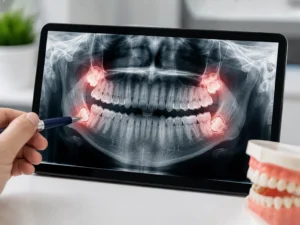
One of the most common questions we hear about wisdom teeth is, “If they are not bothering me, why would I take them out?”
It is a good question, and the answer is not that everyone needs their wisdom teeth removed. Some wisdom teeth erupt normally, stay healthy, and never cause a problem. Others become impacted, develop cavities or infections, damage the tooth in front of them, or create problems that are difficult to treat later.
At Glow Dental in Freeport, NY, we look at wisdom teeth individually. The question is not simply whether you have them. The question is whether they are healthy, whether they can function normally, and what the risk is of leaving them in place.
What Are Wisdom Teeth?
Wisdom teeth are your third molars. They are the teeth located farthest back in the mouth and are usually the last permanent teeth to develop.
Some people have enough room for their wisdom teeth to erupt normally. Others do not. A wisdom tooth can remain completely underneath the gums and bone, partially erupt into the mouth, or grow at an angle toward the tooth in front of it. A tooth that cannot erupt normally is referred to as impacted.
An impacted wisdom tooth is not automatically a problem. Its position, surrounding tissues, ability to be cleaned, and effect on neighboring teeth all matter when deciding whether it should be removed.
When Should a Wisdom Tooth Be Removed?
There are several situations where removal may be recommended.
One of the most common is repeated inflammation or infection around a partially erupted wisdom tooth. When only part of the tooth has come through the gum, bacteria and food can collect underneath the surrounding gum tissue. This can lead to inflammation and infection known as pericoronitis.
Cavities are another concern. Wisdom teeth are located so far back in the mouth that they can be difficult to brush and floss properly. A cavity in a wisdom tooth may sometimes be treatable, but depending on the position of the tooth and the extent of the decay, removing it may make more sense than restoring it.
Gum disease can develop around wisdom teeth as well, particularly when their position makes the area difficult to keep clean.
We also pay close attention to the second molar, which is the important permanent tooth directly in front of the wisdom tooth. An impacted wisdom tooth can sometimes contribute to decay, periodontal problems, or damage involving that neighboring tooth.
Less commonly, cysts or other pathology can develop around an impacted wisdom tooth. These situations require appropriate evaluation and treatment.
What If My Wisdom Teeth Do Not Hurt?
This is where wisdom teeth can be a little misleading.
Pain is certainly a reason to have a wisdom tooth evaluated, but the absence of pain does not tell us everything. A wisdom tooth can have decay, periodontal problems, or be affecting the neighboring tooth before you notice significant symptoms.
That is why dentists do not evaluate wisdom teeth based on pain alone. We look at the tooth clinically and use appropriate dental x-rays to understand its position and what is happening around it.
At the same time, an impacted wisdom tooth that does not hurt does not automatically need to be removed. If there is no evidence of disease and the risks of removal outweigh the expected benefit, monitoring may be appropriate.
The important distinction is between a wisdom tooth that is healthy and being monitored and one that simply has not started hurting yet.
Can I Keep My Wisdom Teeth?
Yes.
If your wisdom teeth have erupted into a functional position, the gums around them are healthy, there is no decay or other disease, and you are able to clean them effectively, there may be no reason to remove them.
Even some wisdom teeth that have not completely erupted may be monitored depending on their position and the individual patient.
Keeping a wisdom tooth does not mean forgetting about it. Your dentist should continue evaluating it during routine examinations and with imaging when appropriate. Wisdom teeth can change over time, so a tooth that is reasonable to monitor today may need a different recommendation in the future.
Why Does My Dentist Want to Check My Wisdom Teeth When I Am Young?
Wisdom teeth are often evaluated during the teenage years because this is when we can begin to see how they are developing and whether there appears to be enough room for them.
The roots of wisdom teeth continue to develop as a person gets older. Their relationship to surrounding structures also matters, particularly in the lower jaw where the roots of lower wisdom teeth can be located near an important nerve.
If a wisdom tooth is likely to require removal, your dentist or oral surgeon can consider its position, root development, your age, your health, and the anatomy around the tooth when discussing the appropriate timing.
This does not mean every teenager should automatically have four wisdom teeth removed. It means this is a useful time to start evaluating them.
Do All Four Wisdom Teeth Need to Come Out?
No.
Wisdom teeth do not have to be treated as a set of four. One may be healthy and functional while another is impacted or developing a problem.
There are situations where removing several wisdom teeth during the same procedure makes sense. If multiple teeth clearly need removal, treating them together may avoid having to go through separate surgeries and recovery periods.
But the recommendation should still be based on the individual teeth and the patient, rather than simply removing four because four are present.
Do Wisdom Teeth Make Your Front Teeth Crooked?
This is a very common concern, especially for patients who previously had braces.
Wisdom teeth are often blamed when the lower front teeth become crowded after orthodontic treatment. However, crowding is influenced by multiple factors, and removing wisdom teeth simply to prevent the front teeth from becoming crooked is not generally supported as a reason by itself.
If you have completed orthodontic treatment, wearing your retainers as prescribed remains important for maintaining the position of your teeth.
So, if your front teeth are starting to shift after braces, your wisdom teeth may not be the whole story. Your retainer deserves some attention too.
What Does the Dentist Look for on the X-ray?
The x-ray gives us information that we cannot get simply by looking inside your mouth.
We look at the angle of the wisdom tooth, how much of it is covered by bone, the development and shape of its roots, the condition of the tooth in front of it, and whether there are concerning changes around the wisdom tooth.
For lower wisdom teeth, we also evaluate their relationship to the nerve that travels through the lower jaw. If the roots appear particularly close to this nerve, additional imaging or evaluation by an oral and maxillofacial surgeon may be appropriate.
For upper wisdom teeth, their relationship to the maxillary sinus can also be relevant when planning treatment.
This is why two wisdom teeth that look similar when you open your mouth can have very different treatment recommendations once we look at the X ray.
Is It Better to Remove Wisdom Teeth Before They Cause Problems?
Sometimes, but not automatically.
If an examination and x-ays suggest that a wisdom tooth has a high likelihood of causing problems or is already beginning to affect surrounding tissues, removing it before it becomes painful may be reasonable.
On the other hand, surgery has its own risks and recovery. Those risks can include pain, swelling, bleeding, infection, dry socket, and, particularly with certain lower wisdom teeth, injury to nearby nerves.
That is why the decision should involve both sides of the equation: the potential risk of keeping the tooth and the potential risk of removing it.
There is no single answer that applies to every patient.
Do My Wisdom Teeth Need to Come Out?
Maybe.
If a wisdom tooth is healthy, functional, easy to clean, and not causing problems for the surrounding teeth or tissues, it may be reasonable to leave it alone and continue monitoring it.
If it is repeatedly infected, significantly decayed, contributing to gum disease, damaging the neighboring tooth, associated with other pathology, or positioned in a way that creates significant concerns, removal may be recommended.
And if the answer is not obvious, that is okay too. Some wisdom teeth are best monitored over time.
The important thing is to make the decision based on an examination and appropriate imaging rather than assuming that every wisdom tooth needs to come out or waiting until it becomes extremely painful.
Wisdom Teeth Evaluation in Freeport, NY
If you are wondering what is going on with your wisdom teeth, Glow Dental in Freeport, NY can evaluate their position, review your dental x-rays, and discuss whether removal or continued monitoring makes more sense for you.
Sometimes the answer is that a wisdom tooth should come out. Sometimes the answer is that it can stay right where it is.
Either way, we would rather make that decision based on what your teeth are showing us.