
Dental Sealants for Kids A Simple Way to Help Prevent Cavities
You make sure your child brushes. You remind them to floss. You bring them in for regular dental cleanings. So why does your pediatric dentist still recommend dental sealants?
Because even great brushing can miss some of the hardest-to-clean areas of a child’s teeth.
At Glow Dental in Freeport, NY, dental sealants are one of the simple preventive tools we use to help protect children’s permanent teeth from cavities, especially during the years when kids are still perfecting their brushing skills.
So, what exactly are dental sealants, and does your child really need them? Here’s what parents should know.
What Are Dental Sealants?
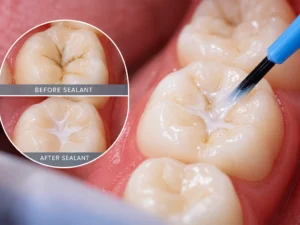
Dental sealants are thin, protective coatings placed over the chewing surfaces of the back teeth, most commonly the permanent molars.
If you look closely at a molar, you’ll notice that the surface isn’t flat. It contains tiny grooves, pits, and fissures that help us chew food. Unfortunately, those same grooves can also trap food particles and bacteria.
Some of these areas are so narrow that even toothbrush bristles have difficulty reaching them.
A dental sealant flows into these grooves and creates a smoother protective barrier over the tooth, helping keep cavity-causing bacteria and food debris out.
Think of it as an extra layer of protection for some of the most cavity-prone teeth in your child’s mouth.
Why Are Sealants Especially Important for Kids?
Children are still learning how to brush effectively, and newly erupted permanent molars can be particularly vulnerable to decay.
One of the biggest milestones happens around age 6, when the first permanent molars typically begin to erupt.
Parents sometimes mistake these teeth for baby teeth because they come in so early. But these are permanent teeth and we want them to last a lifetime.
The Centers for Disease Control and Prevention reports that dental sealants can protect against 80% of cavities in the back teeth for two years after placement and continue protecting against 50% of cavities for up to four years.
That’s a lot of protection from a procedure that can usually be completed in just a few minutes per tooth.
When Should My Child Get Dental Sealants?
Sealants are often recommended soon after the permanent molars have fully erupted.
This commonly occurs around:
- Age 6–7 for the first permanent molars
- Age 11–13 for the second permanent molars
These are general ranges. Every child’s teeth develop at a slightly different pace, so your pediatric dentist will determine when the tooth is erupted enough for a sealant to be placed successfully.
At your child’s routine dental visits at Glow Dental, we can monitor the permanent teeth as they come in and let you know when sealants may be appropriate.
Does Every Child Need Sealants?
Not necessarily.
Dental care should never be one-size-fits-all.
Your child’s dentist may consider the depth of the grooves in the teeth, cavity history, oral hygiene, diet, tooth anatomy, and overall risk for tooth decay when deciding whether sealants would be beneficial.
Some children naturally have very deep grooves in their molars that are difficult to keep clean. Others may have shallower anatomy and a lower risk of developing cavities.
The goal isn’t simply to “seal every tooth.” It’s to identify the teeth that are most likely to benefit from additional protection.
Do Dental Sealants Hurt?
No. Dental sealants do not require drilling or numbing.
For most children, the process is quick and comfortable.
The tooth is cleaned and kept dry. The surface is prepared so the sealant can bond properly, and then the liquid sealant material is carefully applied to the grooves of the tooth. A special curing light is typically used to harden the material.
Your child can leave the office with an added layer of cavity protection without an injection or traditional filling procedure.
How Long Do Dental Sealants Last?
Sealants can last for several years, but they aren’t necessarily permanent.
Normal chewing and everyday wear can gradually cause a sealant to thin, chip, or come off over time.
That’s why we check existing sealants during your child’s regular dental exams. If a sealant is no longer adequately protecting the tooth, your dentist may recommend repairing or replacing it.
Regular dental visits allow us to make sure that protection is still doing its job.
Can You Still Get a Cavity With a Sealant?
Yes. Sealants significantly reduce the risk of decay on the surfaces they cover, but they do not make a tooth cavity-proof.
A sealant protects the grooves on the chewing surface of a tooth. Cavities can still develop between teeth or in other areas that are not covered by the sealant.
Children still need to:
- Brush twice a day with fluoride toothpaste
- Floss between their teeth
- Limit frequent sugary snacks and drinks
- Visit the dentist regularly for exams and cleanings
Sealants work best as one part of a complete cavity-prevention routine.
Sealants vs. Fillings: What’s the Difference?
This is an important distinction.
A dental sealant is preventive. It is placed on a tooth to help prevent a cavity from developing.
A filling is restorative. It is used after tooth decay has already damaged the tooth.
Whenever possible, we’d rather help prevent a cavity than treat one later.
That is one reason preventive dentistry—including regular exams, professional cleanings, fluoride, good home care, and sealants when appropriate—is such an important part of pediatric dental care.
What If My Child Is Great at Brushing?
That’s fantastic—but it doesn’t necessarily mean sealants aren’t useful.
Even adults with excellent brushing habits can have difficulty reaching the deepest pits and grooves of their molars. For children, whose brushing technique and coordination are still developing, those areas can be even more challenging.
Sealants aren’t a replacement for brushing.
They’re protection for the places a toothbrush may have trouble reaching.
Are Dental Sealants Safe?
Dental sealants have been used in dentistry for decades and are recommended as an effective cavity-prevention strategy by major dental and public health organizations.
If you have questions about the specific sealant material being used for your child, don’t hesitate to ask. We believe parents should understand what we’re recommending, why we’re recommending it, and how it benefits their child’s oral health.
Does Dental Insurance Cover Sealants for Kids?
Many dental insurance plans include coverage for sealants on children’s permanent molars, although coverage varies significantly by plan.
Insurance companies may have restrictions based on your child’s age, which teeth are being sealed, how frequently a sealant can be replaced, or whether there is already a restoration on the tooth.
Our Glow Dental team can help review your child’s dental benefits and explain anticipated coverage before treatment.
A Few Minutes of Prevention Can Make a Big Difference
Small preventive steps can make a lasting difference. Dental sealants are a quick, comfortable way to protect your child’s permanent molars from cavities, helping keep these important teeth healthy for years to come.
Looking for a Pediatric Dentist in Freeport, NY?
At Glow Dental, we provide pediatric dental care for children and families in Freeport and surrounding Long Island communities.
Our approach focuses heavily on prevention. During your child’s dental visit, we will evaluate their teeth, check for cavities, monitor the eruption of their permanent teeth, and discuss whether treatments such as fluoride and dental sealants could help reduce their risk of tooth decay.
If your child’s permanent molars are starting to come in or you are simply wondering whether they are due for sealants, schedule a pediatric dental visit with Glow Dental in Freeport, NY.
Because sometimes the easiest cavity to treat is the one we can help prevent in the first place.
Frequently Asked Questions About Dental Sealants
What age should kids get dental sealants?
Sealants are commonly recommended as permanent molars erupt, often around ages 6–7 for the first permanent molars and around ages 11–13 for the second permanent molars. Timing varies from child to child.
Are sealants only for children?
No. Teens and adults can sometimes benefit from sealants as well, depending on their tooth anatomy and cavity risk.
Can you put a sealant over a cavity?
A dentist must evaluate the tooth first. Sealants are primarily used for prevention, and teeth with existing decay may require a different treatment depending on the extent and location of the cavity.
Do sealants require numbing?
Typically, no. Placing a dental sealant does not require an injection or drilling.
How often do dental sealants need to be replaced?
There isn’t one set schedule. Sealants are checked during routine dental exams and may be repaired or replaced if they become worn or are no longer adequately covering the tooth.
Are dental sealants worth it?
For children at risk of developing cavities in the pits and grooves of their permanent molars, sealants can provide an additional layer of protection. Your child’s dentist can determine whether they are appropriate based on the individual tooth and your child’s cavity risk.